Is curcumin the same as turmeric?
No. Turmeric is the whole spice. Curcumin is one of a family of compounds called curcuminoids that make up roughly 2 to 5% of turmeric powder. A 95% extract concentrates them about twenty to forty times.
Curcumin is the main active compound in turmeric (Curcuma longa). Turmeric powder holds only a few percent of it, so supplements use a concentrated extract. The best human evidence is for knee joint comfort, where trials show a modest benefit. Curcumin is poorly absorbed, and people on blood thinners or with gallbladder or liver problems should check with a doctor.
| What it is | A group of compounds, curcuminoids, from turmeric rhizome |
|---|---|
| In turmeric powder | Roughly 2 to 5% curcuminoids by weight |
| In a 95% extract | 95% curcuminoids by weight |
| Amounts used in trials | About 500 to 1,500 mg of curcuminoids a day |
| Acceptable daily intake | 0 to 3 mg per kg of body weight (JECFA) |
| Main cautions | Blood thinners, gallstones, liver conditions, pregnancy |
And how good the evidence is.
| Taken for | Evidence | What the studies show |
|---|---|---|
| Knee and joint comfort | Moderate | Multiple trials in adults with knee joint problems report modest improvement in comfort and mobility. Quality is mixed and products differ. |
| Soreness after exercise | Early | A few small studies suggest less muscle soreness. Doses and formulations vary too much to generalise. |
| Digestion | Traditional | Turmeric has long culinary and traditional use. Trials of curcumin extract for digestion are limited. |
| "Fights inflammation everywhere" | None | Curcumin is poorly absorbed, and broad claims run far ahead of the human data. |
Grades are our reading of published human trials on the ingredient, not tests of this product. Moderate: several controlled trials agree. Some: a few do. Early: small or preliminary. Traditional: long use, little trial data. None: nothing worth quoting. How we grade evidence
Taken from real searches in India.
No. Turmeric is the whole spice. Curcumin is one of a family of compounds called curcuminoids that make up roughly 2 to 5% of turmeric powder. A 95% extract concentrates them about twenty to forty times.
A teaspoon of turmeric powder weighs about 3 g and contains roughly 60 to 150 mg of curcuminoids, depending on the turmeric. A single 500 mg capsule of 95% extract holds about 475 mg.
This is where the evidence is best. A 2016 analysis of eight randomised trials found that about 1,000 mg a day of curcumin reduced pain scores in people with joint problems. The authors said the trials were too few and too small to be definitive, so we grade it as moderate.
Both questions are searched a lot. Evidence that curcumin helps the liver is early and not convincing. Rare cases of liver injury have been reported with turmeric and curcumin supplements, particularly high-absorption formulas. Anyone with a liver condition should ask a doctor first.
In laboratory dishes, yes, as many substances can. There is no evidence that taking curcumin treats or prevents cancer in people. It must never replace medical treatment.
Laboratory studies suggest it may reduce platelet activity. The effect in people is unclear, but anyone taking blood-thinning medicine should check with a doctor before using curcumin.
Curcumin is poorly absorbed on its own. Taking it with a meal that contains some fat helps. Piperine, from black pepper, increases absorption, and it can also change how the body handles some medicines.
Trials have commonly used 500 to 1,500 mg of curcuminoids a day. The international food-additive committee JECFA sets an acceptable daily intake of up to 3 mg per kg of body weight. We do not give personal dosing advice.
No trial has compared them. With a meal is the sensible choice, both for absorption and to reduce stomach upset.
Most trials lasted 4 to 12 weeks of daily use. Longer-term safety data for high-dose supplements is limited.
Nausea, stomach upset and loose stools are the most common, mainly at higher doses. It can worsen gallbladder problems.
It means the extract is standardised so that 95% of its weight is curcuminoids. Curcuminoids are curcumin plus two closely related compounds. The number is only as reliable as the method and lab behind it.
We found no human evidence strong enough to quote for any of these.
People who are pregnant, have gallstones or liver disease, or take blood thinners or other regular medicines should check with a doctor first. Turmeric in food is a different matter and is not a concern.
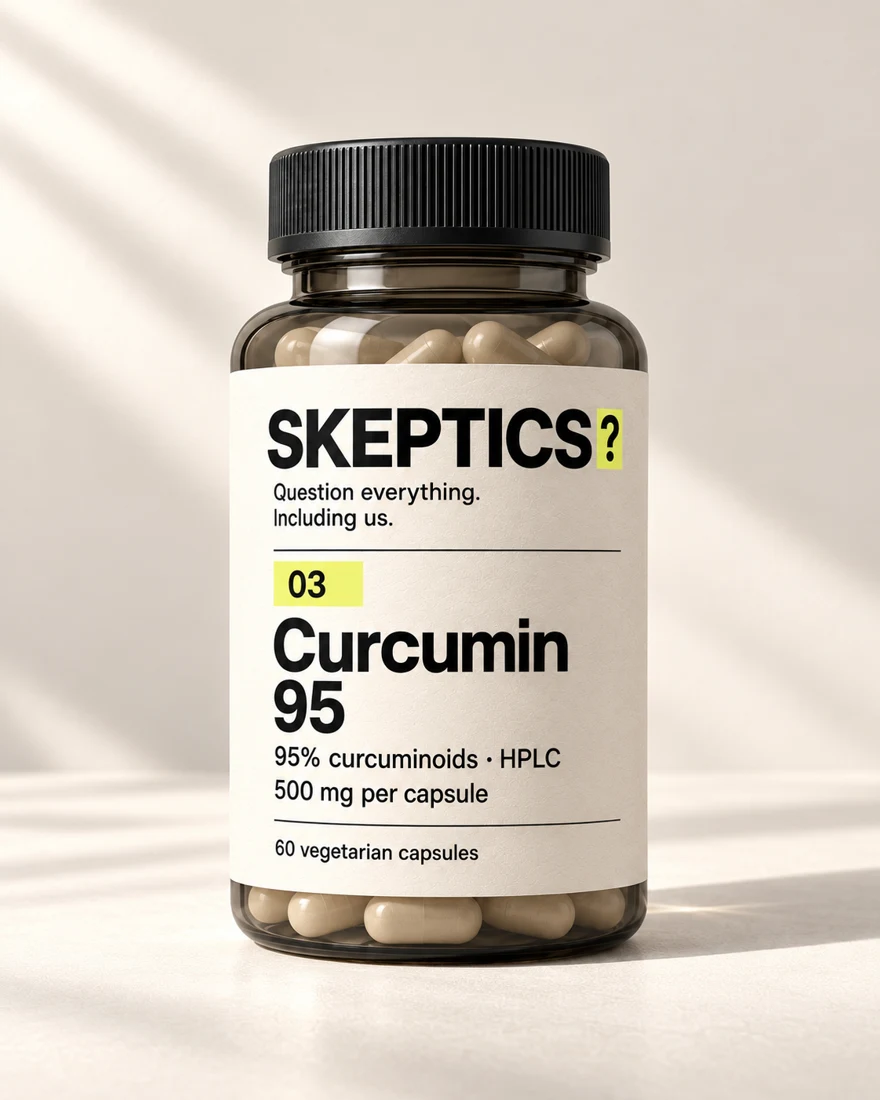 Skeptics Curcumin 95500 mg · 95% curcuminoids by HPLC60 vegetarian capsules · ₹899See the specification
Whichever brand you choose, check the plant part, the active-compound percentage, the method used to measure it, and the heavy-metal results for the batch.
This guide is general information about an ingredient, not medical advice and not a claim about any product. Research on an ingredient is not a clinical trial of a particular supplement. Speak to a doctor before taking any supplement if you are pregnant, breastfeeding, have a medical condition or take medicines.