Does brahmi really work?
For memory, there is some evidence. A 2014 analysis of nine randomised trials with 518 people found that Bacopa extract taken for at least 12 weeks improved speed of attention. The authors said a large head-to-head trial is still needed.
Does brahmi improve memory?
In a 12-week trial of 98 healthy people over 55, 300 mg a day of Bacopa extract improved verbal learning and delayed recall compared with placebo. Other memory measures in the same trial did not differ. The benefit is modest and specific.
How long does brahmi take to work?
About 12 weeks of daily use in the trials that found a benefit. It is not an exam-week supplement.
Is brahmi good for children or for ADHD?
A few small studies have been done in children, but they are not enough to rely on. Do not give brahmi to a child without a paediatrician's advice.
Is brahmi good for hair?
Brahmi oil is a traditional hair application. There are no good human trials showing that taking brahmi improves hair.
Brahmi vs gotu kola (mandukaparni): are they the same?
No. Brahmi usually means Bacopa monnieri. Gotu kola is Centella asiatica, called mandukaparni in Ayurveda. Because both are sold as brahmi in different regions, check the botanical name on the label.
Brahmi vs shankhpushpi: which is better?
They are different herbs. Shankhpushpi is Convolvulus pluricaulis. Brahmi has considerably more human research behind it.
Brahmi vs ashwagandha: which should I take?
They are studied for different things: brahmi for memory, ashwagandha for stress and sleep. Choose by what you want it for.
Can brahmi and ashwagandha be taken together?
They are often combined, and no harmful interaction is known, but the combination has not been well studied. Both can cause stomach upset.
How much brahmi per day?
Trials have used roughly 300 to 450 mg a day of standardised extract. Powder and vati tablets are different products with different amounts. Follow the label.
What is the best time to take brahmi?
No trial has compared timings. Taking it with food reduces the chance of stomach upset.
What are the side effects of brahmi?
Nausea, stomach cramps and more frequent bowel movements are the most reported. They were noticeably more common with Bacopa than with placebo in trials.
Does brahmi affect the thyroid, liver or kidneys?
Animal studies suggest Bacopa may raise thyroid hormone levels, so people with thyroid conditions should check with a doctor. There is no good human evidence of liver or kidney harm at studied doses, but data is limited.
Why do some labels say 50% bacosides and others 20%?
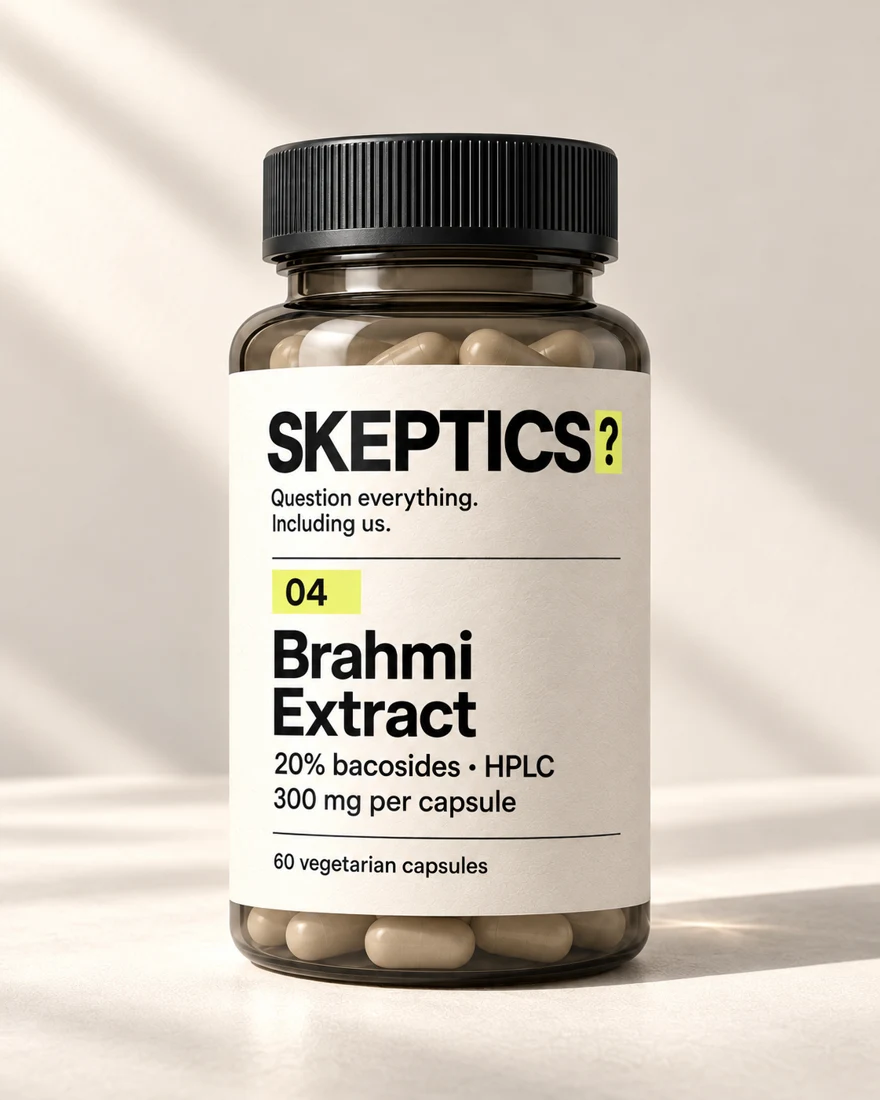
Often because of the test method. UV measurement reads a much higher figure than HPLC on the same extract. A percentage without a method tells you little.