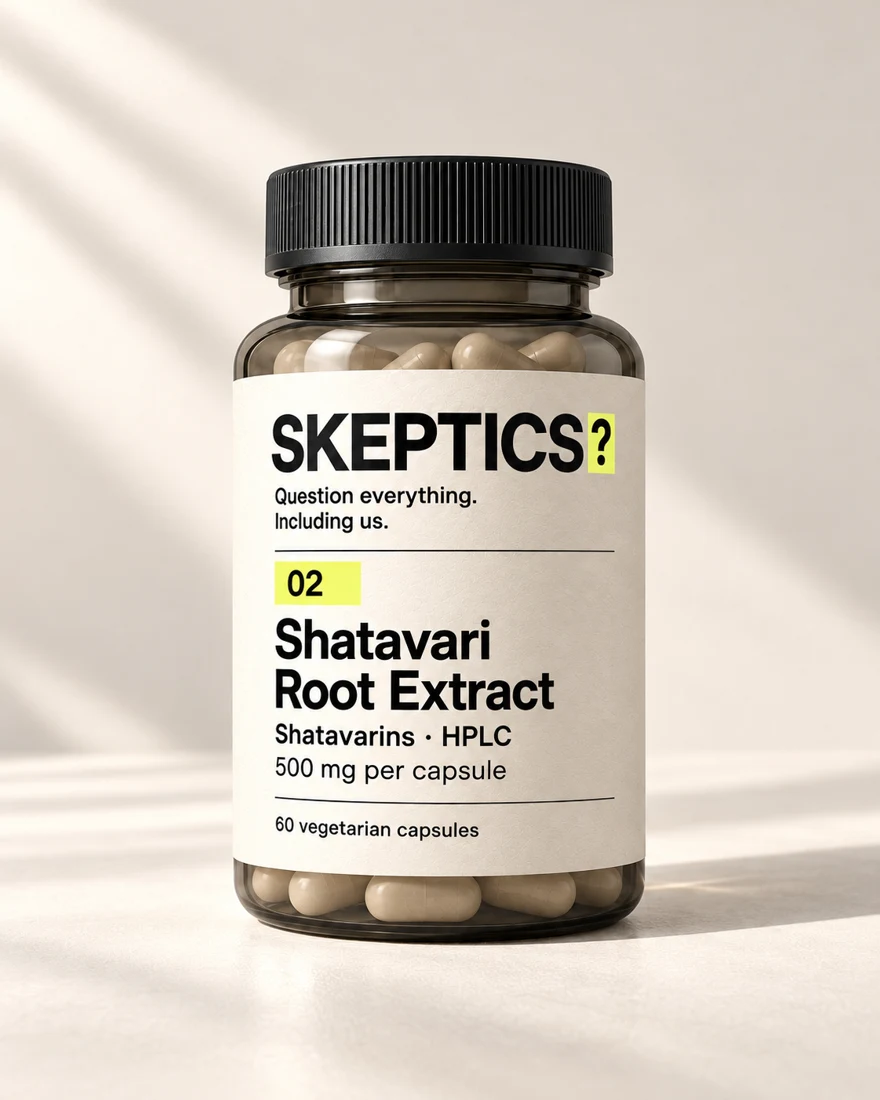
Shatavari Root Extract
Asparagus racemosus
Taken for women's wellness.
Shatavarins measured by HPLC
What it’s
taken for.
And how good the evidence is.
| Taken for | Evidence | What the studies show |
|---|---|---|
| Wellbeing around menopause | Early | A handful of small trials. One widely cited 2025 trial was later retracted, so we do not lean on it. |
| Breast milk supply | Traditional | Long traditional use. The few small trials give mixed results. |
| General women's tonic | Traditional | Centuries of use in Ayurveda. Very little controlled human research. |
| "Hormone balance" | None | A phrase without a measurement. We found nothing worth quoting. |
Grades are our reading of published human trials on the ingredient, not tests of this product. Moderate: several controlled trials agree. Some: a few do. Early: small or preliminary. Traditional: long use, little trial data. None: nothing worth quoting. How we grade evidence
What the
research says.
Shatavari has a long history of traditional use in women’s health. Human trials are few and small; traditional use is not a substitute for clinical evidence.
Read the full shatavari guide: 15 questions answeredIngredient research is not a clinical trial of this product. These findings do not promise an outcome.
Who should check with a doctor first
Check with a doctor first if you are pregnant, breastfeeding, have a hormone-sensitive condition or an asparagus allergy, or take regular medication.
Three questions.
Worth asking.
About any Shatavari product. Ours included.
- 01Saponins or shatavarins?
"Total saponins" is usually a gravimetric figure that counts a broad class of compounds. Shatavarins are specific to this plant and can be measured directly by HPLC. The two numbers are far apart.
- 02Is it really Asparagus racemosus?
Other Asparagus species are sometimes sold under the same name. Identity testing should be part of every batch report.
- 03Extract or plain root powder?
A capsule of plain root powder and a capsule of standardised extract are different products at different costs. The label should say which one you are paying for.
What’s in
the capsule.
| Botanical identity | Asparagus racemosus |
|---|---|
| Source material | Root |
| Amount per capsule | 500 mg |
| Standardisation | Shatavarins; percentage not specified |
| Measurement method | HPLC, not a gravimetric “saponins” figure |
| Pack | 60 vegetarian capsules |
Product specification. Measured values for each batch are on that batch’s report.
Read the
fine print.
An independent report for each finished batch, with the lab, methods, measured values and limits. That’s our commitment.
This is an example of the information to inspect. No results, lab names or certificates have been invented.
How we testThe paperwork.
Without the small print.
Illustrative layout only. No test results or lab identity are represented here.
EXAMPLE LAYOUT / EVERY BATCH COMES WITH ITS FULL REPORT.
A little more
to go on.
Why specify the measurement method?
A percentage needs context. Methods can measure different groups of compounds, so the method should be read alongside the figure.
Where can I inspect a batch report?
Every batch comes with its own independent lab report, published on this site under the batch number printed on the bottle. The layout shown on this page is an example, not a result.
How many capsules are in the bottle?
60 vegetarian capsules. The amount listed on this page is per capsule, not a personalised daily-use recommendation.
The other six.
Stay curious.
We’ll write once.
New batches and their reports, when there’s something worth inspecting. No newsletter, no wellness tips.